
On this page
- Key takeaways
- What does each tool actually do?
- Wordfence vs Sucuri: endpoint firewall or cloud firewall?
- Is Patchstack a firewall, and do you need it with Wordfence?
- Which tool removes malware from a hacked site, and what does it cost?
- Wordfence vs Sucuri vs Patchstack: who should pick which?
- What the evidence does not tell you
- Need help choosing or cleaning up?
- Frequently asked questions
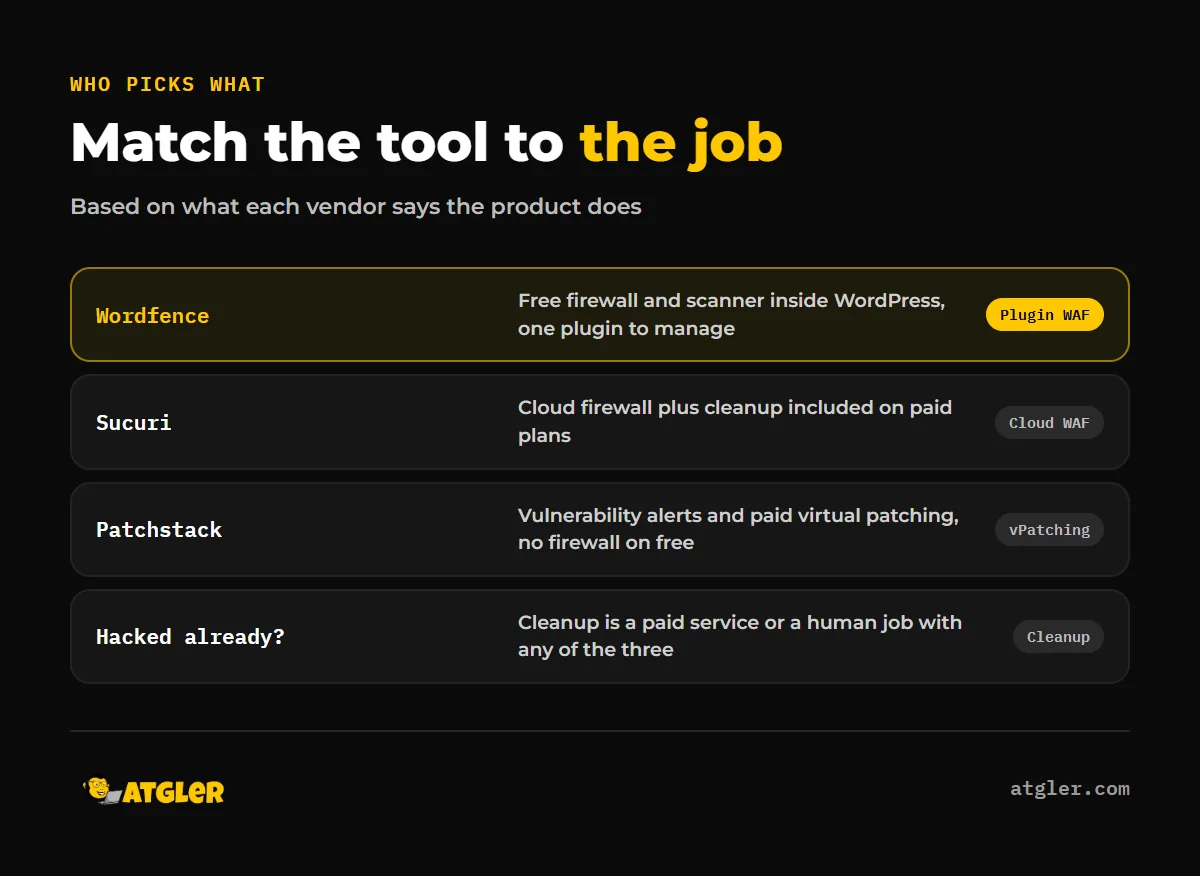
Wordfence vs Sucuri comes down to where the protection runs. Wordfence is a plugin whose firewall and malware scanner work inside WordPress. Sucuri’s firewall is a paid cloud service, and its free plugin only monitors and scans. Patchstack is a third kind of tool: it tracks known vulnerabilities and, on paid plans, adds virtual patching.
This article compares the three by what each is designed to do, then says who should pick which. It is compiled from the WordPress.org plugin directory, vendor pricing pages and vendor comparison pages, current as of November 2026. A plugin alone does not stop every attack, as we cover in does a WordPress security plugin alone stop attacks, so treat any of these as one layer.
Key takeaways
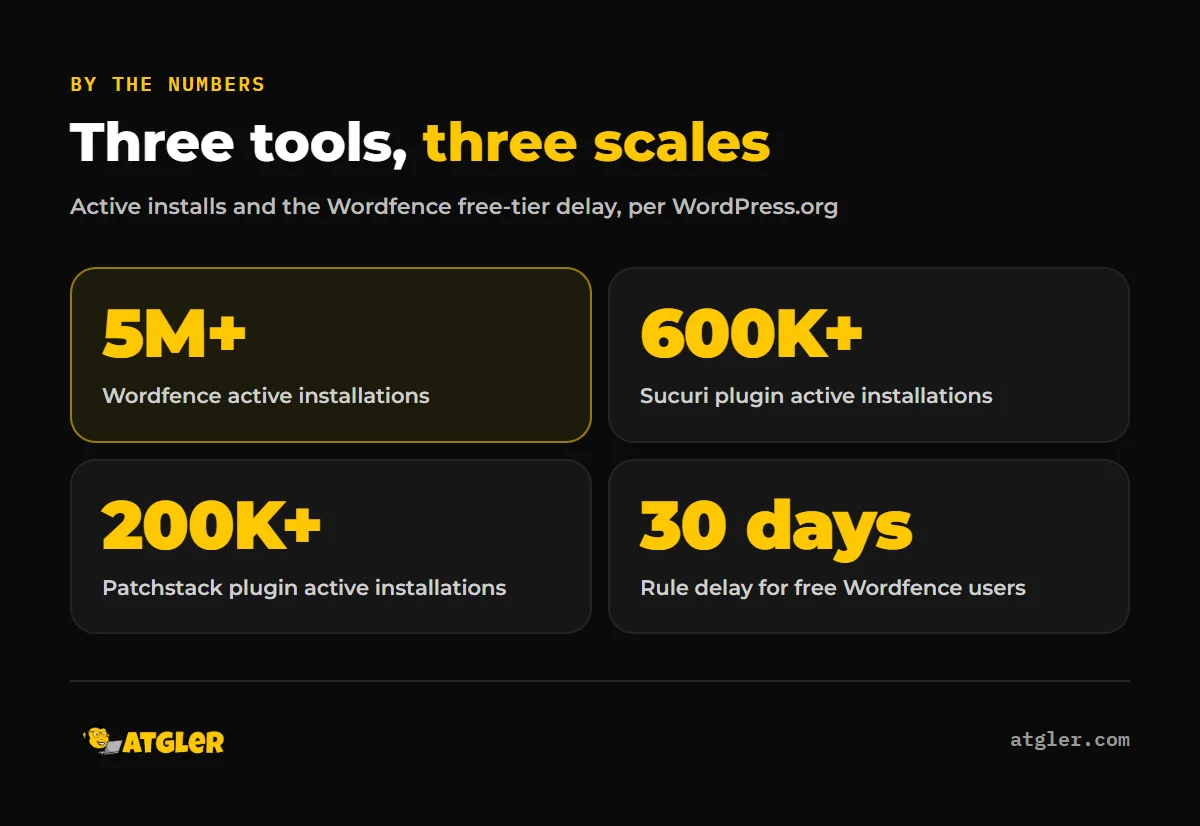
- Wordfence is an all-in-one plugin with an endpoint firewall and scanner. Free users get firewall rule updates 30 days late, according to its WordPress.org page.
- The free Sucuri plugin does monitoring and scanning only. The firewall is a paid cloud service, and cleanup is included on paid plans, per Sucuri’s pricing page (vendor-reported).
- Patchstack is about vulnerabilities, not general malware scanning. Its free plan has no firewall, and virtual patching is paid.
- No independent test comparing the three was available, so effectiveness claims on every side are vendor-reported.
What does each tool actually do?
Each one is built for a different job, which is why a simple “which is best” answer misleads. Here is the split, using the WordPress.org directory pages, which are written by the vendors.
| Job | Wordfence | Sucuri | Patchstack |
|---|---|---|---|
| Firewall | Endpoint WAF inside WordPress | Paid cloud WAF, runs without the plugin | None on the free plan |
| Scanner | Core, theme and plugin files checked against WordPress.org versions; looks for malware, backdoors, SEO spam, malicious redirects | File integrity monitoring, remote scan via SiteCheck, blocklist monitoring | Matches plugins, themes and core against a vulnerability database on a schedule |
| Virtual patching | Not described on its page | Not described on its page | 12,000+ vPatch rules on paid plans (vendor-reported) |
| Cleanup | Repairs changed files from pristine originals; hands-on cleanup is a paid service (Wordfence Care) | Unlimited manual cleanups on every paid plan (vendor-reported) | Not offered as a cleanup tool in its listing |
By directory data, Wordfence has 5+ million active installations and a 4.7/5 rating from 5,052 reviews. Sucuri’s plugin has 600,000+ installations and 4.2/5 from about 386 reviews. Patchstack has 200,000+ installations and 4.8/5 from 62 reviews. Install counts are a popularity signal, not a quality score.
Wordfence vs Sucuri: endpoint firewall or cloud firewall?
An endpoint firewall runs on your own site, while a cloud firewall sits in front of it and filters traffic first. Wordfence is the first kind, and Sucuri’s paid firewall is the second.
Sucuri’s own comparison page argues that filtering before traffic reaches your host is better, and that a plugin lets traffic reach the site first. Wordfence’s page says its endpoint firewall “cannot be bypassed.” Both are self-descriptions by companies selling the product, and neither claim is independently tested. The Sucuri comparison page is also titled “Wordfence vs Sucuri 2022”, and its zero-day figure refers to 2018, so weigh it accordingly.
Does the free Wordfence version leave you unprotected?
Not unprotected, but behind. The free plugin includes the firewall and scanner, yet rule and signature updates reach free users 30 days after Premium users, who get them in real time through the Threat Defense Feed. Premium also adds a real-time IP blocklist, country blocking and ticket-based support. Free support is forum-only.
Does the free Sucuri plugin include a firewall?
No. The plugin does audit logging, file integrity monitoring, remote scanning, blocklist monitoring and hardening. Its page says it is “not designed to replace” Sucuri’s paid products. Plugin vulnerability scanning needs a WAF API key, and the plugin only offers post-hack guidance such as rotating secret keys and resetting passwords.
Can you run Wordfence and Sucuri together?
The vendor pages we reviewed do not say. The pieces differ (a plugin firewall and a cloud firewall), but we cannot point to documentation on how they interact. Ask each vendor before stacking them, and never run two firewall plugins side by side.
Is Patchstack a firewall, and do you need it with Wordfence?
Patchstack is primarily a vulnerability tool, not a general firewall or malware scanner. On the free plan, per its WordPress.org page, it matches your installed plugins, themes and core against its vulnerability database on a schedule, gives up to 48 hours of early warning, covers up to 3 websites, and includes no firewall.
Paid plans add virtual patching, which deploys a targeted rule per site only when a specific vulnerability is detected there. Patchstack cites 12,000+ vPatch rules (vendor-reported). Whether you need it alongside Wordfence depends on how fast you update. If a plugin has a known hole and you cannot update right away, a rule that blocks that one attack is useful. If you update weekly and check the results, the gap is smaller. We could not find a neutral wordfence vs patchstack comparison; Patchstack’s own docs only link to its marketing pages.
Pricing is where the two Patchstack sources disagree. WordPress.org describes a free plan where you can enable vPatching for $5 per site per month. Its pricing page lists a Developer plan at $69 per site per month billed annually ($828 per year), with extra blocks of 5 sites at $12.50 per month, and no free tier. They may be describing different plan structures, so confirm before you sign up.
Which tool removes malware from a hacked site, and what does it cost?
Sucuri is the one that bundles cleanup into its plans. Its pricing page (vendor-reported) lists Basic at $229 per year, Pro at $339, Business at $549 and Junior Dev at $999.98. Firewall-only plans are $9.99 per month (Basic) and $19.98 per month (Pro). It says unlimited manual cleanups are included on every plan, with ticket response targets of 30 hours (Basic), 12 hours (Pro) and 6 hours (Business), and notes that resolution times may vary. It gives no numeric target for firewall-only plans. Its older comparison page says plans start at $199.99, which conflicts with the signup page, so the newer figure is likely current.
Wordfence’s plugin repairs changed core, theme and plugin files by overwriting them with clean originals, and offers a Delete File option. Its own FAQ recommends a full reinstall for hacked sites because Wordfence alone cannot guarantee security, and hands-on cleanup is a paid service. Sucuri claims Wordfence charges $179 per cleanup, but we could not verify that, and we are not quoting a Wordfence price we could not confirm. Check its pricing page directly.
A scanner can also miss things, which we cover in do WordPress malware scanner plugins catch everything. At Atgler, which has worked with WordPress for 7 years and has built, managed and maintained more than 600 sites, we scan by comparing file checksums against clean WordPress files. Our cleanup removes malware, rebuilds core from clean files and patches the vulnerabilities we can identify. A thorough job takes at least 8 hours, and hard cases on old deprecated themes can take up to 50. Our hacked site repair is $149 Standard (48 hr) or $249 Priority (24 hr), flat fee, with a 30-day re-hack guarantee. For typical market costs, see how much WordPress malware removal costs.
Wordfence vs Sucuri vs Patchstack: who should pick which?
- Small site, one owner, tight budget: Wordfence free gives you a firewall and scanner in one plugin. Accept the 30-day rule delay or upgrade.
- You want a firewall outside your hosting and cleanup included: Sucuri’s paid platform fits. The free plugin alone will not give you a firewall.
- You run many plugins and update irregularly: Patchstack’s free alerts (up to 3 sites) are a cheap early warning. Paid vPatching is for sites that cannot always update immediately.
- Agency with many client sites: Patchstack lists Enterprise/Agency custom plans, and its Developer plan prices per site. Compare the per-site cost against your site count before choosing.
On malcare vs wordfence, we have no vendor or directory data to compare, so we are not ranking it. For a wider look, see our best WordPress security plugins comparison. Wordfence’s own FAQ says the plugin alone cannot guarantee security, and the same caution applies to all three tools.
What the evidence does not tell you
No independent test, study or forum dataset we could find measures how often any of these firewalls are bypassed, how much virtual patching covers, or how often cleanups succeed. Every effectiveness claim here is vendor-reported. We also could not confirm Wordfence’s current Premium, Care or Response pricing, and we could not read its firewall documentation for details such as learning mode.
Speed is another gap. Sucuri claims its CDN speeds sites up by “over 70%”, but that is a vendor claim from a page labeled 2022, and we found no data on how any of the three affects load time.
Need help choosing or cleaning up?
If you would rather not manage this yourself, our website care and maintenance plans start from $99 a month, month to month. They cover weekly updates of plugins, themes and core, uptime monitoring, a check that the site works after each update, and a short monthly report. We have seen a backup plugin silently disconnect and stop both backups and downtime alerts, and the site was found hacked later, so someone watching the tools matters as much as the tools themselves.
Frequently asked questions
Is Wordfence or Sucuri better for WordPress?
It depends on the job. Wordfence bundles an endpoint firewall and scanner in a free plugin, while Sucuri’s firewall and cleanup sit in paid plans. No independent test ranks them.
Does virtual patching replace updating plugins?
The sources we reviewed do not say it does. Patchstack describes virtual patching as targeted rules that deploy when a specific vulnerability is detected on your site, which reads as protection while you update, not instead of it.
Is Patchstack a firewall or a vulnerability scanner?
Its free plan is a vulnerability scanner with no firewall. Paid plans add virtual patching rules that block specific known attacks.
Does the free Sucuri plugin remove malware?
No. It scans and monitors, and gives post-hack guidance only. Cleanup is included on Sucuri’s paid plans, according to its pricing page.
Which one slows my site down the least?
We found no independent speed data for any of the three. Sucuri claims its CDN speeds sites up, but that is a vendor claim.
Sources
- WordPress.org: Wordfence Security plugin page (page last modified Nov 10, 2026, vendor-written description)
- WordPress.org: Sucuri Security plugin page (Oct 14, 2026, vendor-written description)
- WordPress.org: Patchstack plugin page (Nov 2026, vendor-written description)
- Sucuri: Security Platform plans (fetched Nov 18, 2026, vendor-reported)
- Patchstack: Pricing (fetched Nov 18, 2026, vendor-reported)
- Sucuri: Wordfence vs Sucuri comparison (titled 2022, competitor-authored, vendor-reported)
- Patchstack Docs: How does the Patchstack firewall compare to Sucuri or Wordfence? (vendor documentation)