
On this page
- Key takeaways
- What are nulled WordPress plugins and themes?
- How do nulled plugins carry backdoors?
- What do documented nulled plugin cases look like?
- Is your site clean after you delete a nulled plugin?
- What does the evidence not tell you?
- What are the safe alternatives to nulled plugins?
- Need help after installing a nulled plugin or theme?
- Frequently asked questions
Nulled WordPress plugins are premium plugins that someone has cracked to bypass the license check and then given away or sold cheaply on unofficial sites. The danger is that the copy can be altered before upload. Security vendor Sucuri says malicious code and backdoors are routinely injected into them, and cracked copies also stop receiving security patches from the developer.
This article explains how nulled plugins and themes are used to plant backdoors, walks through documented cases, and covers legitimate ways to get premium features. If you already installed one and suspect a problem, our hacked site repair service handles the cleanup.
Key takeaways
- A nulled plugin is a paid plugin modified by a third party to bypass license verification, usually downloaded for free from an unofficial site.
- Sucuri (a security vendor) reports that malware is routinely injected before these files are uploaded, and that payloads can stay dormant for weeks or months.
- Cracked copies cannot reach the developer’s update server, so they miss bug fixes and security patches.
- Deleting a nulled plugin in wp-admin may not remove a backdoor it left behind.
- Free repository plugins, freemium tiers, sale-season licenses and open-source alternatives are safer routes.
What are nulled WordPress plugins and themes?
Sucuri defines a nulled plugin as “a premium, paid plugin that has been cracked or modified by a third party to bypass its license key verification.” People typically get them from unofficial sites, often free or at a steep discount. The same applies to nulled WordPress themes.
The appeal is obvious: a $60 or $200 plugin for nothing. The catch is that someone other than the developer edited the code, and you have no way to see what else they changed. Searches for a free premium plugin download are exactly where these sites rank.
How do nulled plugins carry backdoors?
The person who cracks the plugin can add anything to it before uploading it to a download site. Sucuri says malicious code, trojans and backdoors are routinely injected this way, and that payloads can stay dormant for weeks or months before activating.
Once active, Sucuri says they can redirect visitors to phishing pages, skim card data at checkout, deface the homepage or send spam. The 2026 Sucuri article names no specific campaigns and gives no statistics beyond an unsourced estimate that “thousands of WordPress sites get compromised” every year, so treat that number as a vendor claim.
The other costs besides malware
Cracked copies lose access to the developer’s update server. Sucuri says users “won’t receive version updates, bug fixes, or (most critically) security patches.” It also lists DMCA takedown notices, host suspension or account deletion, and “This site may be hacked” warnings in search results as possible consequences.
What do documented nulled plugin cases look like?
The best-documented cases come from security vendors and a news report on vendor research. They are older than ideal, and the notes below flag which are vendor-reported.
A backdoor that survives deletion (Sucuri, 2020)
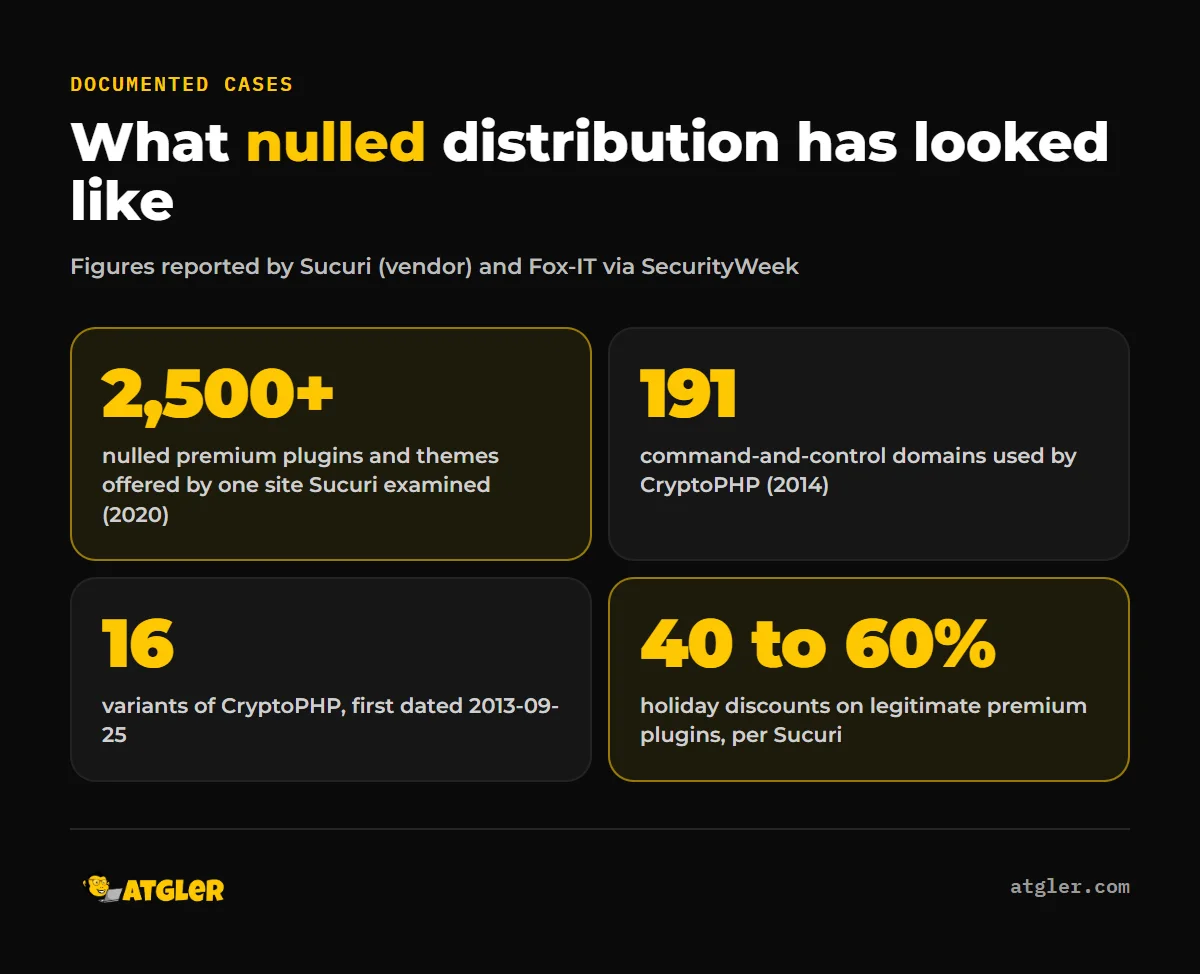
Sucuri researcher Luke Leal found two malicious files, rms-script-ini.php and rms-script-mu-plugin.php, inside pirated plugins from thewordpressclub[.]org. Sucuri says that site offered more than 2,500 nulled premium plugins and themes.
The first file creates a backdoor in the mu-plugins directory. Because of that, deleting the plugin in wp-admin does not remove it: the backdoor “will still exist” at that path. The code logs the attacker in as an existing administrator and reports the site title, home URL, server IP and plugin name to managerly[.]org. Sucuri adds that attackers could also change database content and alter wp-admin CSS to hide their posts.
A nulled theme with a webshell (Sucuri, 2023)
In a February 2023 post, Sucuri’s Nathan Chaddock described a nulled theme found through a top Google result for “free nulled WordPress themes.” It contained theme/inc/class-appside.php, which Sucuri calls “a heavily obfuscated backdoor” and “a WordPress webshell packed with numerous features.”
According to Sucuri, it could disable popular security plugins, infect other server files and send database credentials from wp-config.php to a remote domain. Sucuri also warns that stealthier malware in nulled components may be “less likely to be detected during a downloaded package scan.”
CryptoPHP (Fox-IT, 2014)
SecurityWeek reported in November 2014 on Fox-IT’s CryptoPHP backdoor, spread through pirated premium themes and plugins for WordPress, Drupal and Joomla via sites including Daily Nulled and Nulled Style. Fox-IT estimated “thousands of websites are affected.” It used 191 unique command-and-control domains and 45 IP addresses and was used for black-hat SEO link injection. The first version dated from 2013-09-25, with 16 variants in total.
Is your site clean after you delete a nulled plugin?
Not necessarily. The 2020 Sucuri case shows a backdoor placed in the mu-plugins directory that stays there after the plugin is removed from the dashboard. Our guide on how to find and remove a WordPress backdoor covers the hunt in detail.
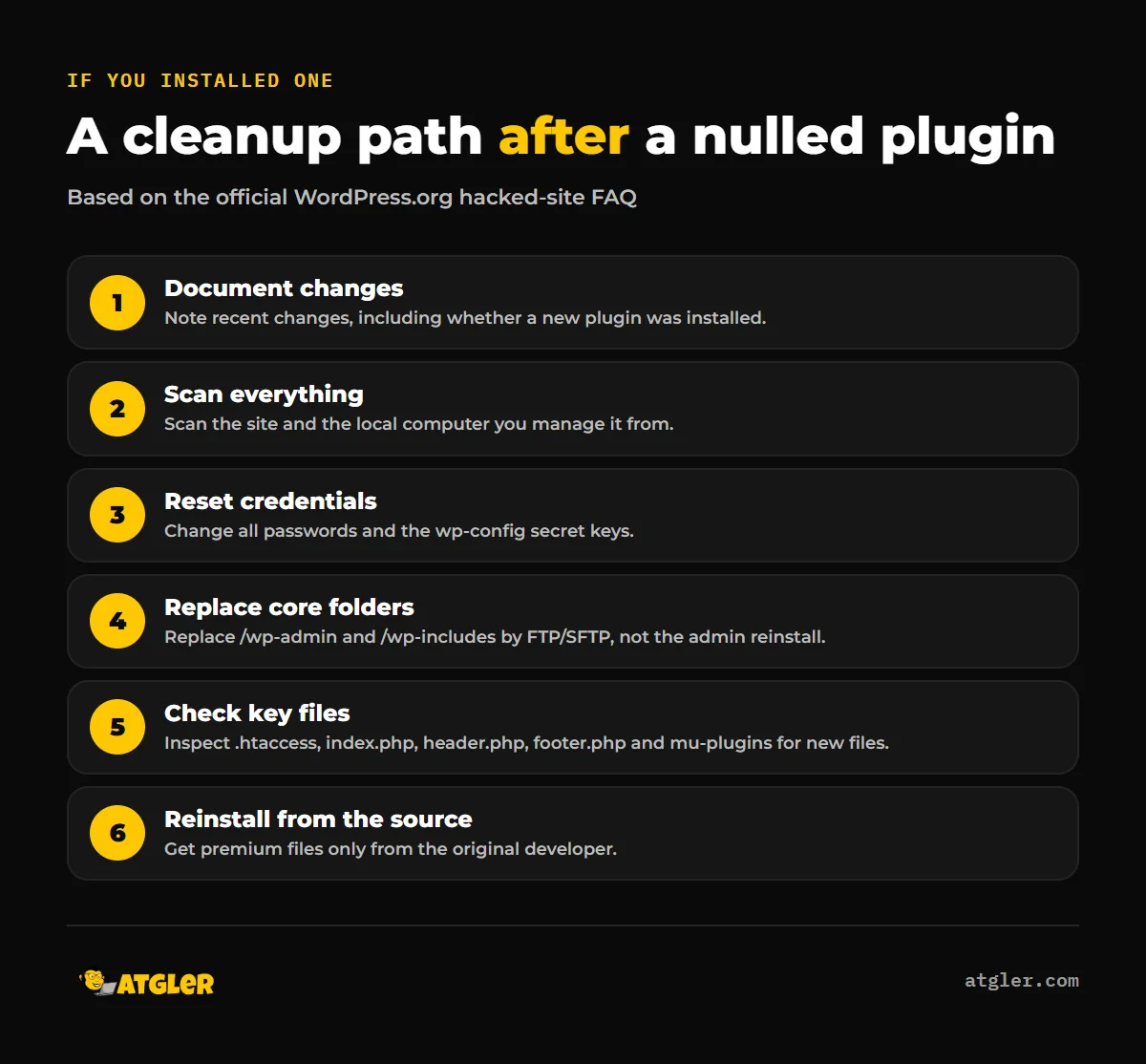
The official WordPress.org “FAQ My site was hacked” page (first published 2018-10-27, last updated 2026-07-26) gives a recovery path. It does not mention nulled plugins by name, but the steps apply:
- Document recent changes, and ask “Was a new plugin installed?”
- Scan the site and the local machine you use to manage it.
- Reset all passwords and the wp-config secret keys.
- Replace /wp-admin and /wp-includes by FTP/SFTP rather than using the admin reinstall option.
- Check .htaccess and files such as index.php, header.php and footer.php, since hacks often add new files.
The same page lists signs of compromise: being blacklisted by Google or Bing, the host disabling the site, unauthorized new users, and the site being used to attack others. Atgler has worked with WordPress for 7 years and has built, managed and maintained more than 600 sites. In cleanups we scan by comparing file checksums against clean WordPress files, rebuild core from clean files, and get premium plugin and theme files only from the original developer. Deleting the plugin is only the first step, not the cleanup itself.
For the full sequence, see our checklist on what to do when your WordPress site has been hacked.
What does the evidence not tell you?
Quite a lot is unproven, and it is worth being clear about it.
- Prevalence. We found no independent statistics on what share of hacked sites came from nulled plugins. For broader context on how sites get compromised, see our WordPress security statistics post.
- Vendor bias. Sucuri sells cleanup and protection services, so its risk claims are vendor-reported. Its 2026 article gives no figures or named campaigns.
- Not every copy is proven malicious. The sources say malware is routinely injected, not that every nulled file contains it. You cannot tell by looking, which is the point.
- Age of examples. The strongest named cases date from 2014 and 2020. The 2023 theme case is also vendor-reported.
- Legality. WordPress.org’s plugin guidelines (header dated March 11, 2026; the body text says March 15, 2024) require GPL-compatible licensing and say plugins “must not do anything illegal, dishonest, or morally offensive.” They do not mention nulled or cracked code, and we did not find a source that settles how the GPL applies to redistributed cracked copies. Sucuri does mention DMCA notices as a possible consequence.
What are the safe alternatives to nulled plugins?
Sucuri lists four legitimate routes. We could not check them against another source, but they are standard options.
| Option | What you get |
|---|---|
| WordPress.org repository plugins | Sucuri cites “tens of thousands of completely free plugins.” |
| Freemium plugins | Core features free, advanced features paid. Upgrade only if you need them. |
| Premium licenses during major sales | Sucuri cites 40 to 60% holiday discounts across the ecosystem. |
| Well-maintained open-source alternatives | Actively developed code you can inspect. |
A genuine license also gives you the developer’s updates. Keeping them current is routine work, and it is what a website care plan covers: weekly updates of plugins, themes and core, plus a check that the site works after each one. Plans start at $99 a month, month to month.
Need help after installing a nulled plugin or theme?
If a site is redirecting visitors, showing search warnings or has admin users you do not recognize, the plugin may be only part of the problem. We use one standard cleanup procedure on every infected site: it removes malware, rebuilds core from clean files and patches the vulnerabilities it can identify. We do not promise to prove how a site was hacked, and restoring a site exactly as it was is not always possible if data was deleted. Our hacked site repair is a flat fee of $149 Standard (48 hr) or $249 Priority (24 hr), with a 30-day re-hack guarantee.
Frequently asked questions
Are nulled plugins illegal?
Sucuri says they can lead to DMCA takedown notices. We did not find a source that settles how the GPL applies to cracked copies, so for a legal answer ask a lawyer.
Do all nulled plugins contain malware?
Sucuri says malware is routinely injected, but no independent figure shows how often. Since you cannot verify the code by eye, treat every nulled copy as untrusted.
How can I tell if a plugin is nulled?
If it did not come from the original developer or WordPress.org, assume it is suspect. Sucuri warns that stealthier malware may evade package scans, so a clean scan is not proof.
Can my host suspend my account for using nulled themes?
Sucuri lists host suspension or account deletion as a possible consequence. It does not say how often hosts act on this.
Will a nulled plugin hurt my search visibility?
Sucuri says a compromised site can show “This site may be hacked” warnings in search results. The WordPress.org FAQ also lists blacklisting by Google or Bing as a sign of compromise.
Sources
- Sucuri: The Security Risks of Using Nulled WordPress Plugins (2026-03-30, vendor-reported)
- Sucuri: Pirated WordPress Plugins Bundled with Backdoors (2020-07-08, vendor-reported)
- Sucuri: The Dangers of Installing Nulled WordPress Themes & Plugins (2023-02-16, vendor-reported)
- SecurityWeek: Backdoored CMS Plugins Used to Hijack Web Servers (2014-11-21, news report on Fox-IT research)
- WordPress.org Developer Resources: Detailed Plugin Guidelines (header dated 2026-03-11; body text says March 15, 2024)
- WordPress.org Documentation: FAQ My site was hacked (first published 2018-10-27, last updated 2026-07-26)